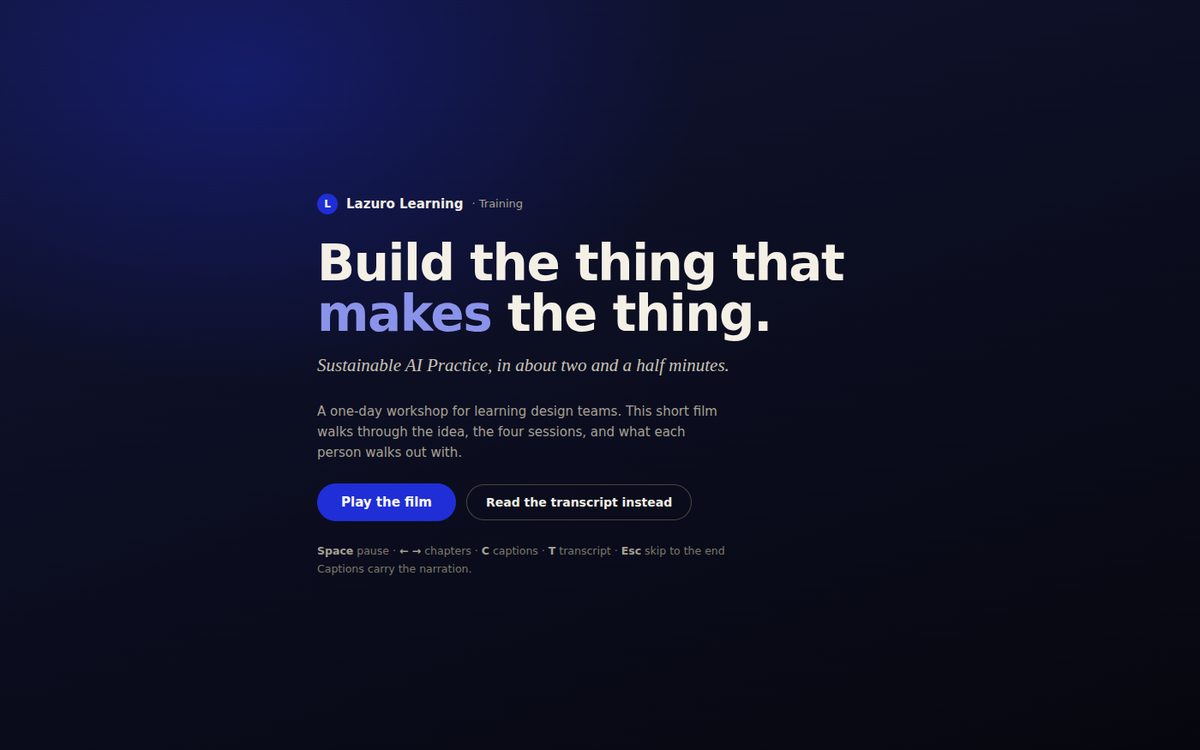
Build the thing that makes the thing.
A one-day, hands-on workshop for learning design teams. Most AI training teaches prompting, which buys you one output, and then another, and then another. This teaches your team to use AI to build the tool that makes the outputs. Once. Then free, forever.
What the day covers, in one short film
The idea, the four sessions, and what your team walks out with. Captions are on; press T for the full transcript.
There are two ways to spend a model
You can spend it on the output, or you can spend it on the thing that makes the output. Almost everyone does the first, because that's what the interface invites. The second is where the leverage is.
What you get is consumable
You describe what you want, the model produces it, and the transaction is over. Tomorrow's version starts from nothing.
- The cost recurs on every single use, and scales with how much you use it
- You get a slightly different answer each time, so nothing stays consistent across a curriculum
- Your content has to leave the building, which means a privacy conversation before anything ships
- When the vendor changes the model or the pricing, your workflow changes with it
- The team's skill doesn't accumulate. The dependency does
What you get is an asset
You use the model once, to construct the thing that produces the output. Then you own a working tool.
- Paid for once. Running it a thousand more times costs nothing
- Deterministic. The same input gives the same output, every time, which is what a curriculum needs
- Runs entirely in the browser or on your machine. Nothing to upload, nothing to get approved
- Still works when the subscription lapses, the API key rotates, or the model is deprecated
- Your team now knows how to build the next one
Everything in my showcase was built this way
This isn't a position I argue for and then quietly ignore. Every piece of work on this site is a durable artefact: built with AI assistance, running without it.
Long Take
Makes short camera films from words, a process or your own data, in the browser. Zero model calls at runtime, just maths and WebGL. Use it ten thousand times for nothing.
The UNIVERSEity
An entire institution as a navigable structure. Point it at a different org chart and it regenerates, with no model, no API key and no per-use cost.
Sonic Spectres
Generates its audio examples live in the browser using the Web Audio API, rather than shipping or generating sound files.
One day. Everyone leaves with something that runs.
Delivered in-house for your team, on site or online. No coding experience assumed. Participants use AI to write the code, so what they're learning is how to direct it and how to tell when it's wrong.
The distinction
Consumable output versus durable artefact, and how to tell which one a task deserves. We work through real examples where each is the right call, including the cases where reaching for a tool would be over-engineering.
Audit your own work
Every team has tasks it performs over and over with minor variation: SCORM wrappers, accessibility passes, quiz reformatting, brand-token application, converting a subject-matter document into a storyboard. Participants map their own, and we identify which ones are secretly a tool waiting to be built.
Build one
The core of the day. Each participant picks a real task from their audit and builds a working tool for it, with AI assistance and with me in the room. This is where the method stops being a concept, including the part where the first attempt doesn't work and you learn how to say why.
Ship it and keep it alive
Getting the tool to colleagues who won't install anything, keeping it working without a maintainer, knowing when something has outgrown a single file, and how to make the case to a manager or a procurement team for building rather than subscribing.
What each person leaves with
One working tool they built themselves, running with no subscription and no API key. A repeatable method for spotting the next one. And a plain-language way to explain the choice to whoever holds the budget.
Who it's for
Learning and instructional designers, L&D teams, academic developers, curriculum and content teams. Useful whether your team has been using AI daily for a year or is still arguing about whether to allow it.
When generative AI genuinely is the right answer
A workshop that told you never to generate anything would be selling you a rule instead of a judgement. There are tasks where a live model earns its cost, and the day covers those honestly.
Genuine unpredictability
When the whole point is that you can't script it. An open-ended roleplay has to respond to whatever the learner actually says, and no tool can precompute that.
Variation at scale
Two hundred distinct practice items, each plausible and each different. That's a job for a model, not for a template with a random function.
The blank page
First drafts, alternative framings, arguments against your own design. Thinking-with, rather than producing-for.
And yes, I build generative AI into learning too
The Conversation Builder calls a model on every turn of every conversation, because AI roleplay is squarely in the first category above: it can't be precomputed, and a scripted branching tree isn't the same product. I'll happily tell you why that spend is worth it. I'll just as happily tell you that most of what a learning design team does each week isn't that, and shouldn't be paid for that way. A workshop that pretended otherwise would be marketing rather than training. Try it yourself →
How it runs
Format
One full day, in-house. On site anywhere in Australia, or online in two half-day blocks if your team is spread out.
Group size
Six to twelve. Small enough that I can sit with each person during the build session, which is the part that makes the day work.
What you need
A laptop each, a browser, and access to an AI assistant your organisation already permits. No software to install and no admin rights required.
Preparation
A short conversation beforehand so the examples come from your actual work. Generic exercises are the reason most workshops don't survive contact with Monday.
Afterwards
Written notes, the worked examples, and a follow-up session a month later to look at what people have built since. Included, not an upsell.
Pricing
Scoped in conversation, like everything else here. It depends on group size, location, and how much tailoring the pre-work needs.
Your team is already paying for this twice.
Once in subscriptions, and again in the work they redo every time. Let's talk about a date.
Get in touch